


Introduction
Academic writing is evolving with the advent of large language models like GPT-5. These AI tools can generate coherent, scholarly text on almost any topic, and many researchers are already using them to draft parts of manuscripts (often quietly)[1]. The appeal is obvious: an AI assistant can save time by producing a decent first draft or suggesting alternative phrasings, or even writing an entire research article end-to-end.
But the benefits come with big, glaring caveats. AI models often hallucinate, they might make up facts or even entire references. In one study, about 30% of the references ChatGPT provided for medical questions were bogus[2]. This particular issue is largely mitigated by the "thinking" models, and in particular, deep research mode of GPT and other models linked directly to verifiable sources that you can double-check, Though there are still watch outs with these models to consider. Additionally, an out-of-the-box AI tends to produce generic, soulless prose. You can often spot an AI-written paragraph by its formulaic tone and lack of a clear point of view (or characteristic overuse of em dashes and contrast sentences “why does this matter?”, “let’s dive in”… classic GPT verbiage). Despite these issues, AI writing tools are here to stay and will likely become more common ( perhaps even essential) for efficient scientific communication. The key is using AI thoughtfully: as a partner to augment your writing, not a shortcut to avoid the work.
Journals have already started seeing AI-related mishaps. A paper in 2024 slipped through peer review with an AI-generated figure of a rat that had impossible anatomical features (promptly leading to a retraction)[3]. We probably all remember the story about the lawyer who used fabricated cases from ChatGPT in a real-life courtroom and the backlash there. Similar mishaps are occurring for academic writing as well. Cautionary tales like this underscore that while AI can boost productivity, using it blindly can undermine your credibility[4]. So with that preamble, let’s review a few Do’s and Don’ts and I’ll walk through the common prompts I use for academic writing tasks.
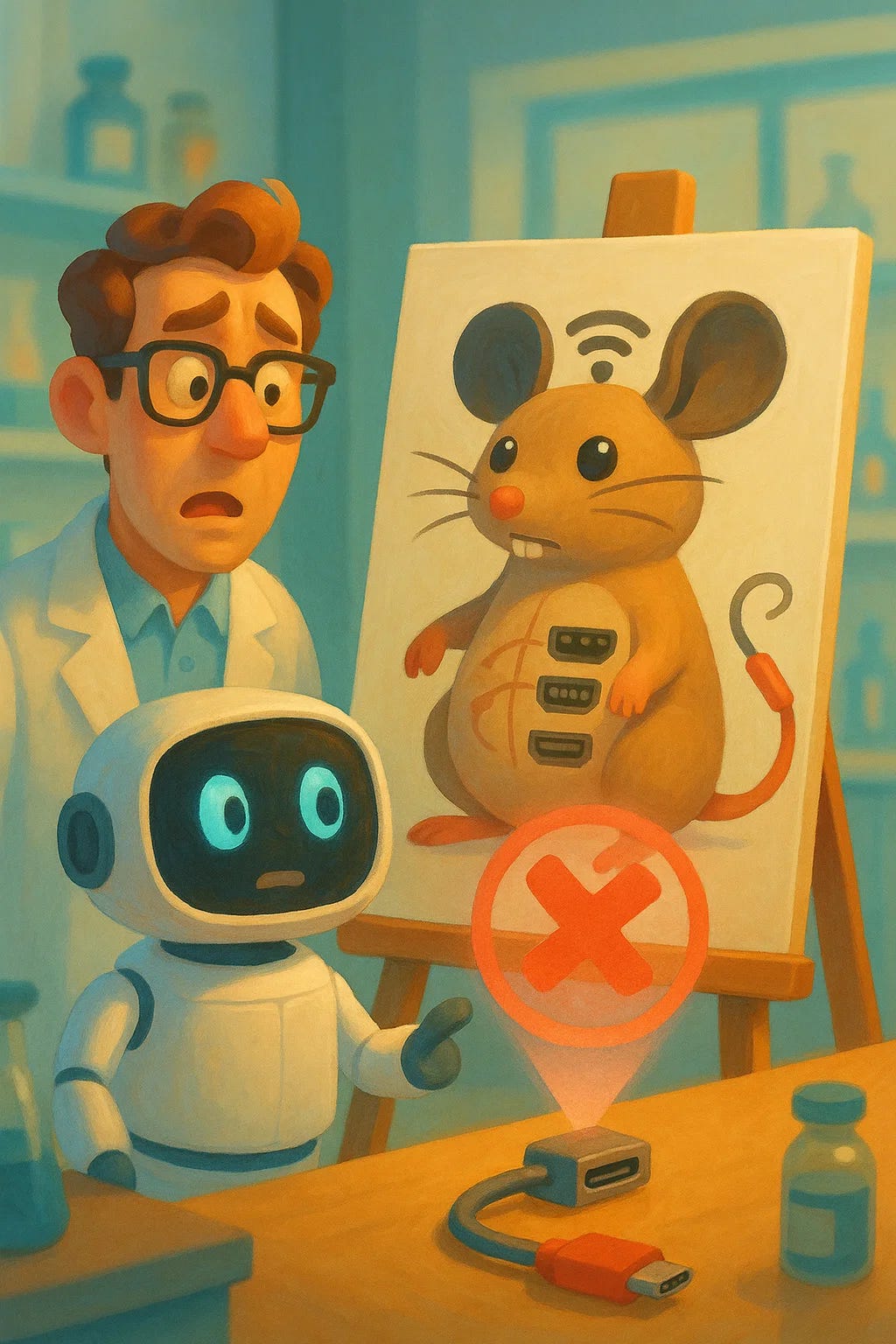
An AI generated figure of a rat in a peer-reviewed article gave everyone a laugh except probably for the author of the article when the retraction happened…
Do’s and Don’ts: Using AI as a Writing Partner
Treat AI as a partner, not a replacement. Here are some best practices and pitfalls:
· DO use AI for brainstorming and overcoming writer’s block: Facing a blank page? Prompt the AI to generate an outline or a draft paragraph to get ideas flowing. Use its suggestions as a starting point that you will refine.
· DO use AI for polishing language: If a sentence or paragraph is clunky, an AI can suggest a clearer or more academic phrasing. This is especially handy for non-native English speakers to improve grammar and tone.
· DO leverage AI for tedious bits: Outlining methods or routine descriptions? If you feed the AI the key points (e.g. study design, sample size), it can draft the narrative around it. Just double-check for accuracy afterward.
· DON’T use AI to invent content or data: Never have the AI fabricate results or references. It should not be used to do your analysis or make scientific claims for you. if you do use it for a first pass analysis, then make sure that you have someone who can check the results who is a domain expert. AI is not a substitute for conducting actual research or analysis.
· DON’T let AI bypass your critical thinking: If the AI writes “Clearly, X causes Y,” you must verify that yourself. You are the scientist, and you know the nuances. Always confirm that any claim the AI makes is supported by your data or sources.
· DON’T rely on AI as the final editor: AI can miss subtle errors or logical gaps. Always do a human pass. Ensure the tone and style match your voice. A section left entirely in AI’s generic style can stick out and weaken your paper (or breed distrust in your readers).
ALWAYS disclose the use of AI tools to generate writing for academic purposes.
By following these guidelines, you get the efficiency boost from AI while keeping full control over your content. In my experience, the best results come when AI handles the mundane drafting or rephrasing, and the human author injects the insight, context, and final polish.

A Few AI Writing Tools to Know
· ChatGPT (GPT-5), Claude, Gemini (Deep Research): The versatile general LLMs can assist with nearly any writing task. With plugins or “research” modes, they tend to cite sources and pull in literature. These are my primary tool for AI-assisted writing (we’ll get into that). I also am a fan of NotebookLM.
· Consensus and Elicit: AI-powered literature search engines. They find and summarize research papers to answer your questions, often with citations – useful for quick background research. I think these are nice, I was an early adopter of Consensus, and I like it fine and I have paid for it in the past, but I candidly don't use them often.
· Scite (now Semantic Scholar’s SciSpace): Allows you to ask questions to a paper or get AI explanations of scientific text. It’s handy for digesting sources and checking citation contexts.
· Editing Aids (Grammarly, Paperpal): These use AI to catch grammar mistakes and improve clarity. They’re not generative, but they complement your writing by fine-tuning language (especially helpful if writing in a second language).
Note: Many specialized “AI paper writer” tools exist, but they mostly use the same underlying models. A general tool like GPT-5, guided well by the user, is often more flexible than a one-size-fits-all academic writing AI.
AI for scientific writing has its perils and pitfalls if you don’t put guardrails on the track to productivity…
Ethical and Practical Considerations
Using AI in writing raises important ethical questions and Most journals now explicitly address the use of AI for writing and their policies. Keep these in mind:
· Disclosure: Be transparent about AI use. Most journals now require authors to acknowledge if AI was used in preparing the manuscript[5]. For example, Elsevier’s guidelines say authors must include a statement if generative AI was used[6]. It’s better to disclose up front than risk issues later. In practice, we add a line in our papers like, “We used ChatGPT (GPT-4) to assist with drafting the introduction, with careful human review of the content.”
· Authorship and Accountability: Never list an AI as an author – journals have made it clear that authors must be human and able to take responsibility[7][8]. You, the human, are accountable for everything in the paper. That means if the AI writes something incorrect, you are on the hook. Always verify facts, numbers, and references that the AI generates[9]. If the AI cites a study or statistic, check that the study exists and says what the AI claims. (AI-generated false citations have already caused scandals in published papers, so be vigilant.)
· Avoiding Plagiarism: Ensure the AI isn’t copying large chunks of text from sources. Generally, GPT models paraphrase, but if you prompt with a specific article, the output might unintentionally mimic it. Treat AI output like a draft written by a research assistant; you would check that it’s not plagiarizing and that all sources are properly cited.
· Data Privacy: Don’t feed sensitive or unpublished data into a public AI model. For instance, never paste your full draft manuscript or confidential patient data into ChatGPT, it could violate privacy or journal embargo policies. Some organizations (like ICMJE) have even told reviewers not to put manuscripts into AI tools that can’t guarantee confidentiality[10]. Use AI for general writing help, not for anything that involves protected or proprietary information unless you have a secure, approved system. Always also double check your institution’s policies
· Use AI to assist, not to deceive: The scientific method and scholarly contribution should come from you. AI is a tool to help articulate and refine your ideas. Using AI to generate content beyond what you intend (for example, to write a whole section you don’t fully understand) crosses into unethical territory. Also be aware that some top journals (e.g. the Science family journals) currently ban AI-generated text in submissions entirely[11], considering it not original. Always follow the specific policy of the journal you’re targeting.
In short, use AI responsibly: be open about it, double-check everything, and remember that it’s your name on the paper, so the intellectual ownership and accuracy of the work must remain with you.
How to Use AI in Your Writing Workflow (Step-by-Step)
Alright how do you actually integrate AI into writing a paper? Here’s a streamlined approach that I and others have found effective along with a few prompts
1. Outline your section first: Before involving the AI, clearly jot down the points you want to cover. This helps you guide the AI and ensures your ideas shape the narrative. For example, if I’m writing the Introduction of a paper on primary care follow up after hip fracture surgery, I note the problem (low follow-up rates), why it matters (patients might miss important care), what’s known from past studies, and the gap my study addresses. I also do this with pure word vomit sometimes dictating my thoughts using WisprFlow on my phone or at my desktop with long prose and let AI organize my thoughts into something more coherent before kicking off deep research.
Write a detailed prompt for the AI: Convert your outline into a specific prompt with instructions. Include the section type (e.g. “Introduction”), key points to cover, and any requirements (tone, length, need for citations). I have several prompts I like below.
