Does Digital Health Actually Work?
The Evidence for eCKM Interventions and How to Build an ACCESS Program That Hits the 50% Threshold

This is Part 9 of a 12-part Techy Surgeon operator series on the CMS ACCESS Model. To navigate this series start to finish, check the archives if you’re a subscriber or check out this page on Techy Policy.
Building for ACCESS? RevelAi Health helps virtual care and digital health teams stand up the AI-powered care coordination and mandatory CMS compliant reporting infrastructure required to operate in models like ACCESS. We augment value-based healthcare operations for care organizations with responsible agentic AI superstaffing and automation so you can focus on clinical care, not checkboxes.
→ Book a demo: Here | Contact us by email: Here
The ACCESS Model arrives at an awkward moment for digital health. CMS is betting that technology-enabled care can improve outcomes and reduce costs for some of Medicare’s most expensive chronic conditions. Yet the digital health industry itself is grappling with uncomfortable questions about efficacy, cost-effectiveness, and staying power. After a decade of enthusiasm and over $100 billion in venture funding, we are finally getting honest assessments of what these tools actually deliver.
This matters because the ACCESS Model’s eCKM and CKM tracks represent the largest potential market for digital chronic disease management in Medicare history. Hypertension, diabetes, dyslipidemia, obesity, chronic kidney disease, cardiovascular disease—these are the conditions that digital health companies have been chasing for years. Now there’s a pathway to scale. The question is whether the evidence supports the promise.
For operators preparing ACCESS applications, this article synthesizes the best available evidence on digital interventions for cardio-kidney-metabolic conditions, maps that evidence to the specific requirements in the eCKM track, and provides practical tools for program design.

The eCKM Track: What You’re Signing Up For
Before examining the evidence, let’s be precise about what the ACCESS Model requires. The eCKM (Early Cardio-Kidney-Metabolic) track targets beneficiaries at the earliest stages of metabolic disease—before diabetes, before cardiovascular events, before kidney failure. Understanding exactly what CMS expects is essential for evaluating whether your program can deliver.
Qualifying Conditions (RFA, page 8, 16):
Beneficiaries qualify for eCKM if they have either:
Hypertension alone, OR
Two or more of the following: dyslipidemia, obesity or overweight with central obesity marker (waist circumference >40 inches for men, >35 inches for women), prediabetes
This is important: you must provide care for all qualifying conditions a beneficiary has within the track, not just the primary diagnosis (RFA, page 16). A patient with hypertension, dyslipidemia, and prediabetes requires integrated management of all three.
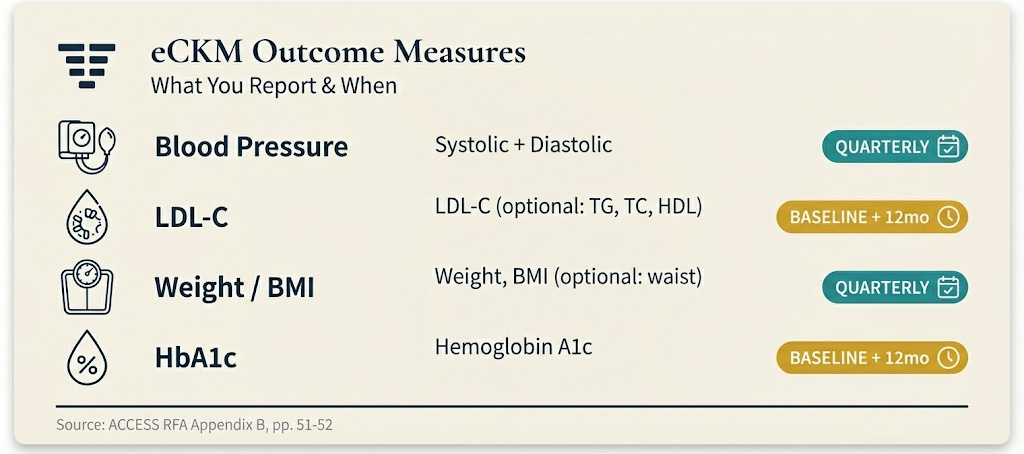
Required Outcome Measures (RFA, Appendix B, pages 51-52):