
I'm So Healthy
I'm a doctor. I stopped going to the doctor.

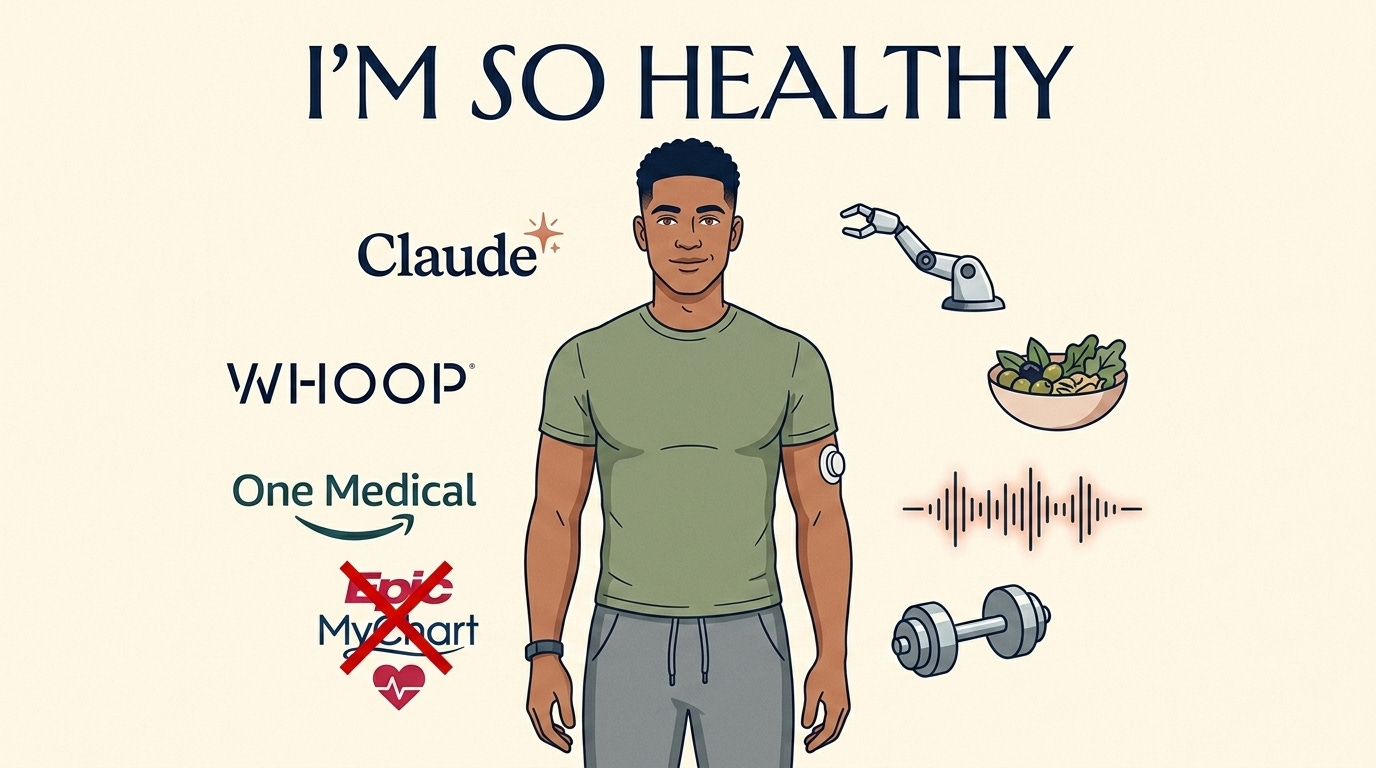
For almost a year now I’ve felt like I don’t need a primary care doctor.
It’s not that I don’t think doctors know what they’re doing. I am one. I think I’m tremendously capable. I just couldn’t get an appointment with mine for like 7 months. And then they left the practice and my new doctor they offered is only available on days I’m busy. And I love being busy. So I improvised.
I got my labs with WHOOP. Next day. $119.99. Dropped them into Claude Code with my biometrics, wrote a prompt that crawls the internet for PubMed-cited articles, and between that and the occasional OpenEvidence query, I’m good. I haven’t given thought to the water waste or data center build considerations of my usage. That seems like a future me problem.
It’s working, which is annoying for anyone who wants me to see a doctor. My sleep is better. My HRV is up mega. Switched to mostly Mediterranean and plant-based by building a shopping list in a live artifact and having Claude order my groceries and meal plan for me. I started taking pictures of my food to count calories, lost 10 pounds in as many weeks. Set up a scheduled task that sends me a healthy tip a day. I have zero questions sent to My Chart the last year, because my Claude doctor built from my lab panel and second brain on Obsidian (I call him Dr. Atlas) knows me better than my primary care doctor ever could, answers 100x faster, cites his sources, and has a better attitude.
Also I forgot my login and I hate MyChart.
Anyway. I’ve got a bunch of AI agents now and they automate the hell out of my life. Never been more productive. My mac mini runs optimizations on my schedule and my health and my habits, nonstop. Grip strength, next level. Box jumps, next level. Longevity is the new life flex and I’m flexing. I think I’ll live forever. It’s definitely possible. Maybe on Mars.
If something came up Amazon One Medical would find me an appointment in minutes. Virtual care only. That’s the way to go.
Maybe if I get cancer. Then maybe I’ll go to the doctor. But I’ll ask Claude or ChatGPT first what to ask, and ask it again after the visit to double-check the plan.
For now I’m healthy and I’m opting out unless I really need it. If I need surgery, then sure I’ll go in and get checked out.
And if I need surgery, I want my surgeon to use a robot.
The AI Grand Rounds Presentation Chain: Open Evidence → Claude Cowork → Gemini

Full video workflow step by step below.
How I Turned NotebookLM Into a Lifelong Learning Engine, and Built a Claude Skill So You Can Too

A Friday in April. A new CMS rule had dropped overnight, 1,590 pages of it, and I was reading the summary on my phone between cases. By lunchtime I had five tabs open: the Federal Register PDF, a KFF explainer, two Health Affairs pieces, and a Substack hot take. I needed to understand the model structure well enough to brief a health system CEO the foll…
The 6 AM Dispatch: How I Use Claude Cowork to Run Five Parallel Workflows Before Breakfast

It’s 6:15 on a Saturday morning. My kids and wife are still asleep. The inbox hasn’t yet become unmanageable, and the hospital hasn’t called. These are the hours I guard most jealously, and increasingly, I spend them in conversation with Claude.
Yes, the EHR Is Going to Kill Your AI Startup

Last summer, Epic launched its native AI Charting tool in partnership with Microsoft—an ambient scribe embedded directly into the clinician workflow. One CIO called it a “watershed moment.” He wasn’t wrong. When the company that controls 42.3% of acute care hospitals and nearly 55% of hospital beds
Sure it's satire, but none of it is untrue. And I am increasingly wondering about this era of consumer adjacent health AI-- I say consumer adjacent because health policy is catching up. The wearables and the virtual visits are going to be covered by insurers, and the willingness to pay for this mode of care is increasing. AND I joke but it has been a very convenient and pleasant experience to have care augmented by AI and the expanding wellness+ health industry...so where does this leave the traditional health system? Largely intact for complex care, but the sands are shifting below are feet.
The satire works because it is mostly true, and that is the uncomfortable part. The consumer AI front door is not winning because it is better medicine, it is winning because you could not reach your own primary care doctor for seven months, and a system that cannot answer the phone has already ceded the ground. I build these kinds of tools and I wear the wearables, so I am not the skeptic in the corner. But from the ER I see the failure mode of the I am so healthy dashboard up close: the person who optimized every number and still walked in with the one thing none of those numbers were watching. A wearable gives you precision, not accuracy, and an agent that sounds certain is not the same as one that is calibrated. The open question for me is governance: when Dr. Atlas is confidently wrong, who is accountable, and how does the patient ever know?