


1. Blue Cross Says AI Is Inflating Your Hospital Bill. Not so Fast…
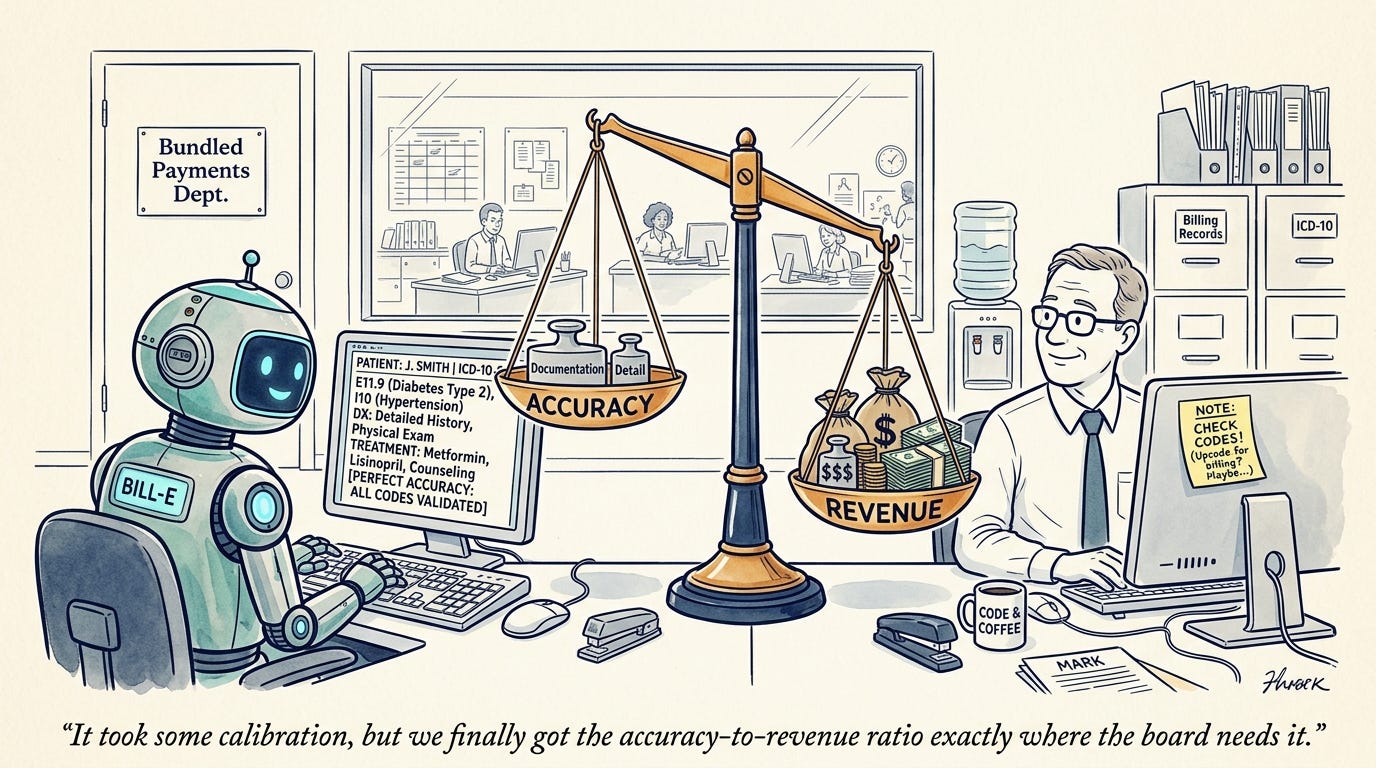
Blue Cross Blue Shield dropped a study this month claiming that hospitals using AI for coding and billing are systematically upcoding — and the data looks convincing. AI-assisted documentation tools capture clinical complexity that human coders routinely miss. When that complexity gets translated into higher-acuity codes, reimbursement goes up. BCBS wants you to call that a problem.
I’m an orthopedic surgeon who codes his own cases. I also build AI tools for clinical care coordination. So let me offer a different frame: what BCBS calls “upcoding,” most clinicians would call “accurate coding.” The documentation gap has always been a problem. Physicians have historically under-documented and under-coded because the cognitive load of clinical work doesn’t leave bandwidth for billing optimization. AI closes that gap. Whether that’s a crisis depends entirely on what you think the documentation was supposed to reflect in the first place.
What the AI vendor community may not want to hear: BCBS isn’t entirely wrong, either. In a fee-for-service model, every improvement in documentation fidelity mechanically increases billings. This is reflective of an incentive architecture failure. This is, frankly, the strongest argument for bundled payments I’ve seen in years materializing in the marketplace. Under CMS’s TEAM model, where hospitals receive a fixed episode price for joint replacements and spinal fusions. Perhaps in models like this, AI stops being a billing optimizer and starts being a care coordinator. Of course, these models are far from perfect, and upcoding is rampant in value-based care contracting where coding uplift impacts risk adjustment.
2. 200 Bills, 50 States, Zero Coherent Strategy
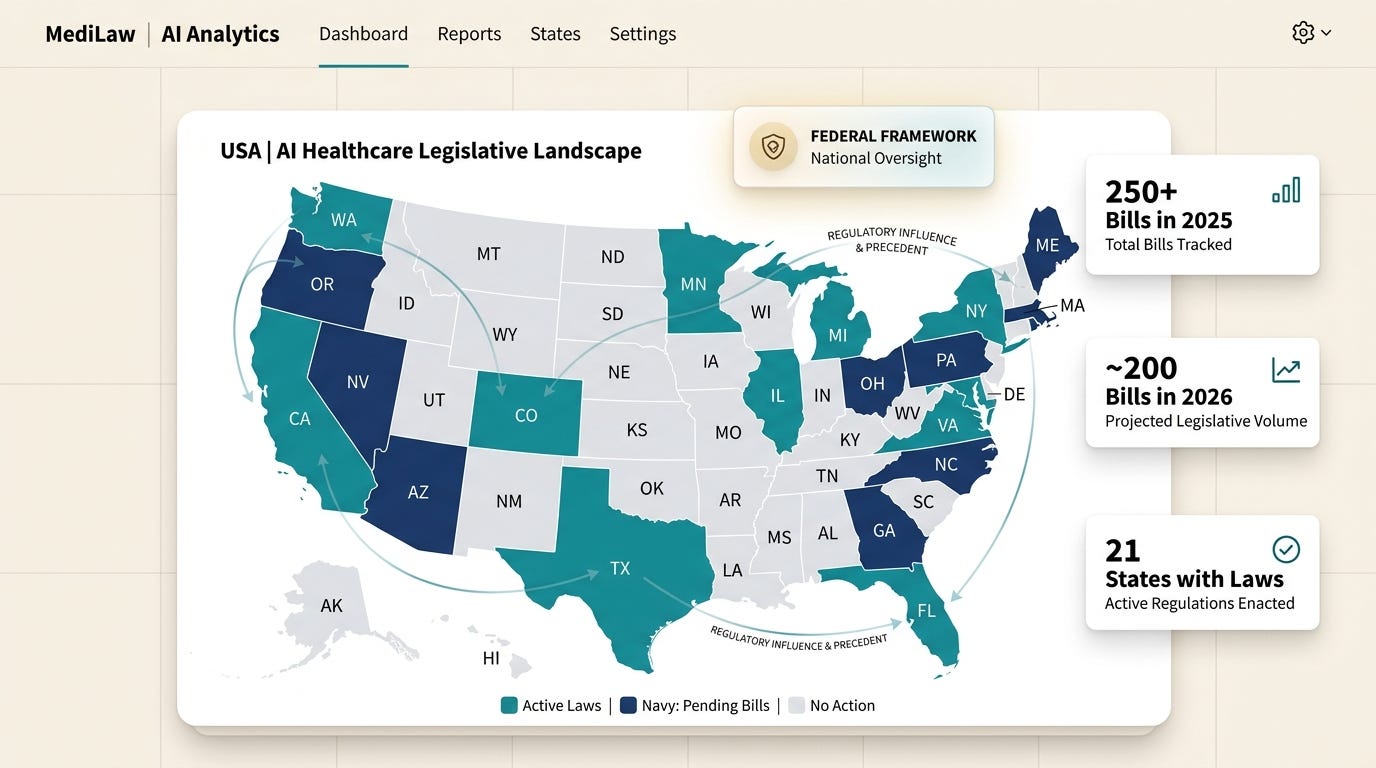
If you build patient-facing AI in healthcare, your compliance is getting significantly more complicated. Healthcare Brew reported this week that roughly 200 state-level AI bills have been introduced so far in 2026, on top of the 250+ from 2025, 33 of which became law across 21 states. California’s companion chatbot law took effect January 1st. Texas’s TRAIGA is live. Illinois, Nevada, and Utah are all regulating AI chatbots with different definitions, different disclosure requirements, and different enforcement mechanisms.
Meanwhile, on March 20, the White House released a National AI Policy Framework recommending, among other things, federal preemption of “burdensome” state AI laws and the creation of regulatory sandboxes. The framework reads pro-innovation, but the healthcare specifics are thin, and Congress hasn’t shown the speed to match.
For operators: you’re deploying AI across state lines into a regulatory environment that changes quarterly. The compliance cost is legal review, but it’s also engineering time, UX changes (disclosure language varies by state), and the organizational overhead of tracking which rules apply where. For small companies building clinical AI, this is a barrier to scale. For large EHR vendors, it’s a moat. The patchwork favors incumbents with compliance infrastructure. If you care about innovation in healthcare AI reaching the patients who need it, you should care about whether these 200 bills are making things safer or just making things harder.
3. TEAM at Three Months: The Quiet Education of 750 Hospitals
We’re one quarter into CMS’s mandatory TEAM bundled payment model, and something interesting is happening. 750 hospitals across 188 markets are now living inside episode-based economics for joint replacements, hip fractures, spinal fusions, CABG, and bowel procedures (729 hospitals when accounting for the sites that were able to opt out). 2026 is the upside-only year — hospitals can share in savings but don’t bear downside risk yet. That changes in 2027, when up to 20% of episode spending is at risk.
The hospitals paying attention are using this year to learn rather than to earn. And the lessons are uncomfortable. Post-acute spend like skilled nursing, home health, and readmissions is where the variance lives. Two patients with the same DRG can have episode costs that differ by $15,000 depending on what happens after discharge. The hospitals that invested in patient engagement, care management resources, and care coordination technology before TEAM launched are likely already seeing tighter cost distributions. The ones that didn’t are starting to understand what it costs to not know what’s happening with your patient on day 8.
HFMA’s analysis makes clear that 2026 is a learning window, not a vacation. The hospitals treating it as the latter will feel the pain when downside risk arrives and compounds. The first question I ask health system leaders selected for this model “What do you know about your patients between discharge and their first follow-up visit?” The ones who answer with confidence are the ones who’ll thrive under TEAM. Site of service shift continues to be a lever to pull that begins upstream with appropriate risk stratification, physician alignment, and care redesign.
4. Physician AI Adoption Doubled…but Where?
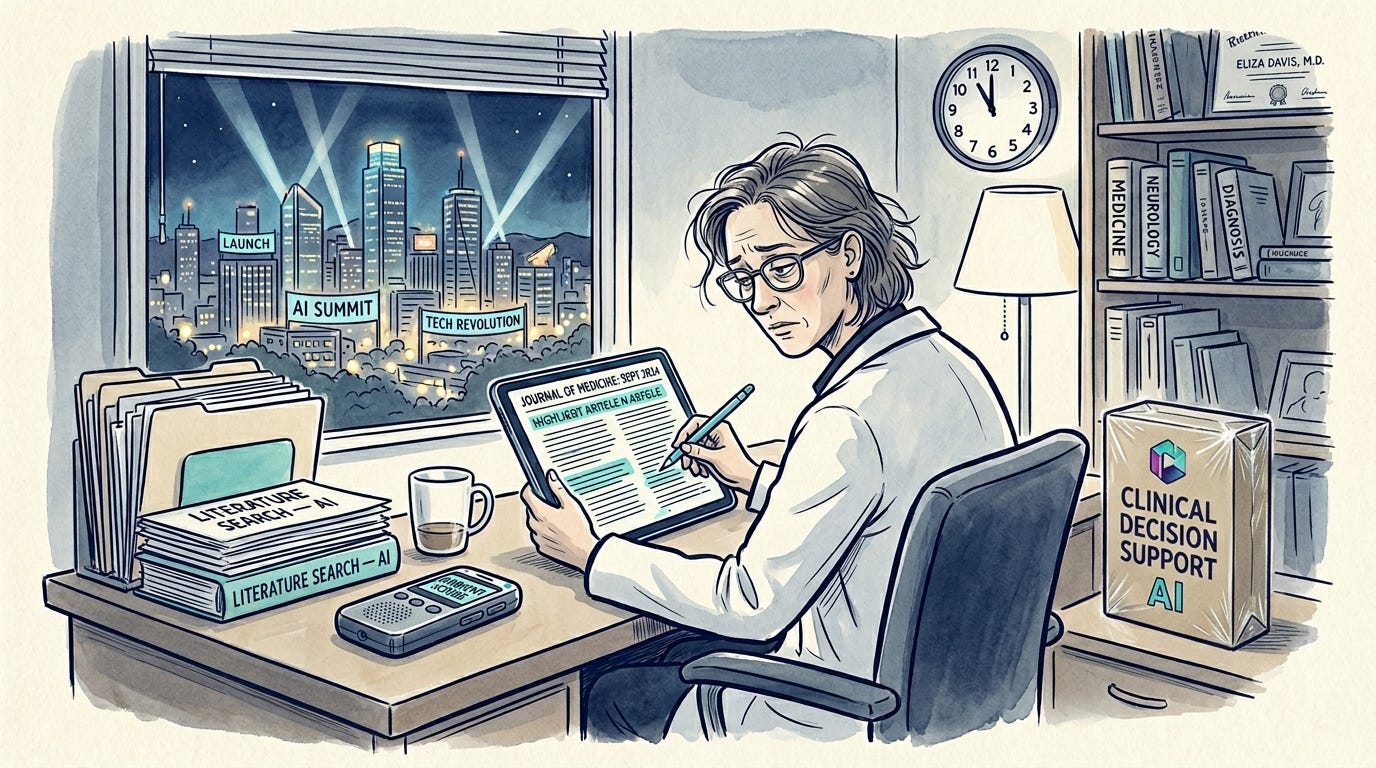
The AMA’s latest survey is a datasets that rewards a second look. The headline — 63% of physicians now use AI professionally, up from 47% in April 2025. Yes, adoption is accelerating. But the use-case breakdown is more nuanced: literature search leads at 35%, voice documentation follows at 29%, and clinical decision support trails behind.
Physicians adopted AI where the pain was already unbearable. Literature search — trying to stay current with an impossible volume of evidence — has been a known crisis for decades. Voice documentation emerged because physicians were spending 8.5% less time in EHRs with ambient scribes, clawing back clinical time from a system that had stolen it. These aren’t the sexy use cases that keynote speakers highlight at HIMSS. But they’re the ones doctors chose with their behavior.
The gap between adoption interest and clinical decision support pours cold water on the “AI will replace doctors” crowd. Healthcare Dive reports that 70%+ of physicians still cite accuracy and reliability as their top barrier. Physicians trust AI with administrative tasks (documentation, search) far more than clinical judgment. That’s rational. And it should shape how we build.
5. $50 Billion for Rural Health Meets the AI Readiness Gap
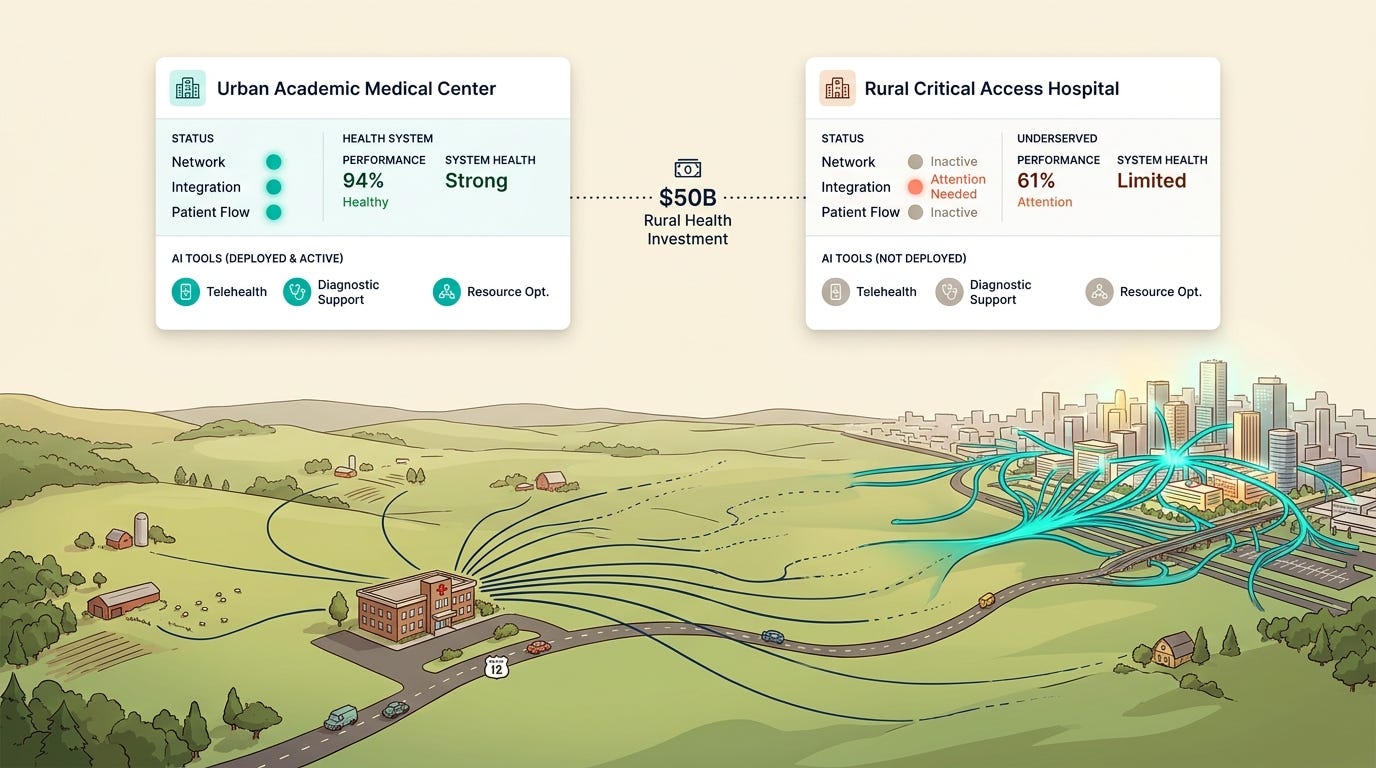
CMS announced $50 billion in awards for the Rural Health Transformation Program. This is $10 billion annually through 2030, spanning all 50 states. The investment targets primary care access, value-based care adoption, and workforce stabilization in the communities where health outcomes are worst and resources are thinnest.
This is unambiguously good policy. But there’s a tension embedded in it that I’ve already noted in discussions with state health leaaders. Healthcare Dive reported this month on safety-net providers struggling to adopt AI even as Medicaid cuts loom. Rural hospitals face the same structural disadvantage: the communities with the greatest health needs have the smallest IT teams, the least structured data, and the fewest resources to evaluate, procure, and implement AI tools. A $50 billion investment in rural health transformation that doesn’t specifically address AI readiness risks creating a two-tier system: one where well-resourced urban systems accelerate with AI while rural systems fall further behind.
The fix isn’t complicated in concept: shared-services models for AI infrastructure, cloud-based tools designed for low-IT-capacity environments, and reimbursement structures (like the ACCESS Model launching in July but with better risk adjustment and provider incentives) that make digital health economically viable in small-volume settings. Yes, rural health deserves this investment. But is the investment structured appropriately to prevent the AI divide from becoming a permanent health access gap? Time will tell.
6 (Bonus). $125 Million Says the AI Governance Layer Is Now Its Own Category
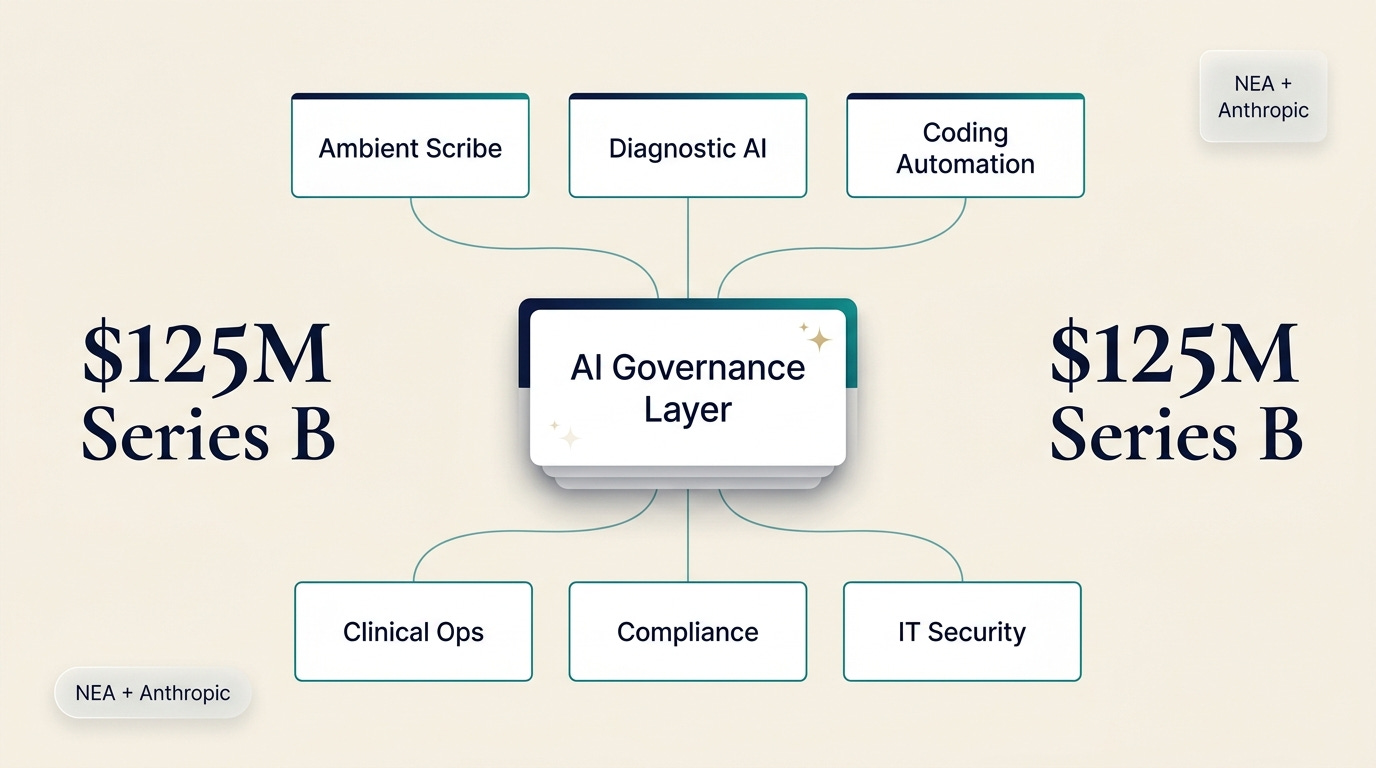
Qualified Health just closed a $125 million Series B led by NEA, with Anthropic among the participants. Their pitch: help health systems build, manage, and govern their own AI tools. Not another point solution. An operating layer.
The first wave of healthcare AI funding went to the tools themselves — ambient scribes, diagnostic models, coding automation. The second wave is going to the infrastructure that manages those tools. Qualified Health is betting that health systems don’t need one more AI product; they need a way to safely orchestrate the dozen they’ve already bought. If you’ve spent any time inside a health system IT department in 2026, you know this resonates. The average academic medical center is now juggling AI tools from Epic, from specialty vendors, from homegrown research teams, and increasingly from departments that just started using ChatGPT without telling anyone. The governance problem is operational.
What’s particularly interesting about the investor composition: Anthropic’s participation suggests the frontier model companies see health system governance as strategically important to their own adoption. If hospitals can’t safely manage AI deployment, they’ll slow-walk it, and that’s bad for everyone building foundation models. The governance layer is becoming the enabling infrastructure for everything else.
What I’m Reading This Week
📖 “From Promise to Practice: The Next Era of AI in Health Care” — NEJM Catalyst lays out the implementation challenges that separate AI demos from AI that works in real clinical environments. Required reading for anyone shipping clinical AI products.
📖 “The landscape of AI implementation in US hospitals” — Nature study: 71% of acute-care hospitals now have predictive AI in their EHRs. The stat of particular interest: AI-supported hospitals reported clinician burnout dropping from 51.9% to 38.8%.
📖 Rock Health: Healthcare Innovation at the Turn of 2026 — The most useful mapping of what’s now vs. what’s next in digital health. Especially worth reading for the ACCESS Model analysis and the digital twins section.
Christian Pean, MD, S is an orthopedic trauma surgeon, CEO and co-founder of RevelAi Health, and faculty at Duke University School of Medicine and the Duke Margolis Institute for Health Policy. He writes about healthcare AI, policy, and the messy intersection of clinical care and technology at Techy Surgeon.
cool series